



Pourquoi le triton alpin ?
© Morgane Fournier
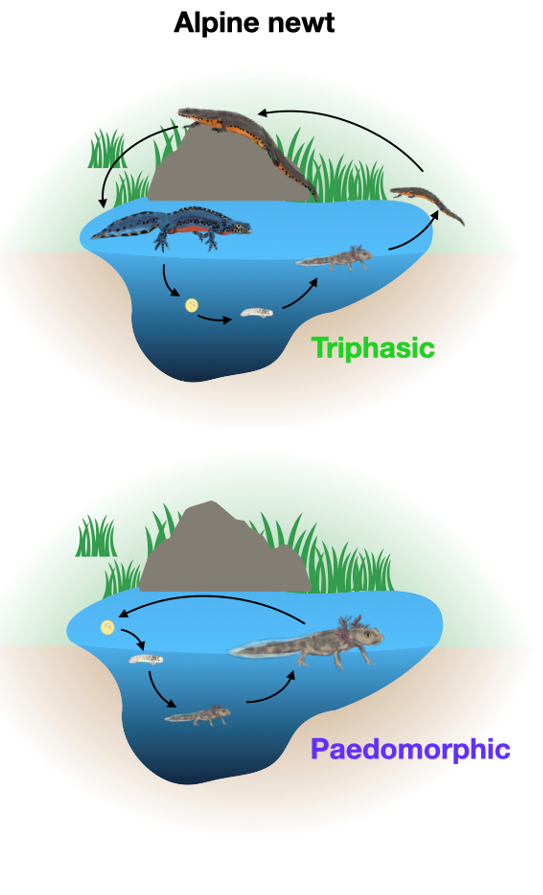
Au cours de son cycle de vie, le triton alpin, comme de nombreux amphibiens, passe par plusieurs stades (cf. triphasique) : il naît sous forme d'œuf, puis devient une larve, un juvénile et enfin un adulte. Ces différents stades s'accompagnent de changements morphologiques importants, notamment lors de la métamorphose. Sous l'effet des hormones, cette phase entraîne une restructuration complète de l'organisme : certains organes et tissus se transforment pour permettre au triton de passer d'un mode de vie aquatique à un mode de vie principalement terrestre.
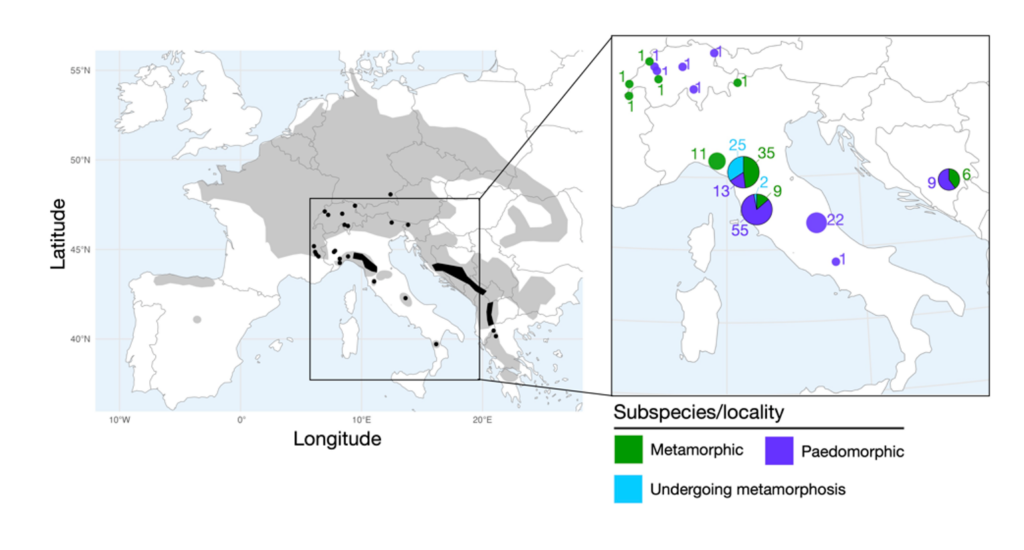
Cependant, toutes les populations de tritons alpins ne suivent pas ce schéma. Dans certaines populations, que l'on trouve principalement en Italie et dans les Balkans, la métamorphose peut s'arrêter avant d'être entièrement achevée. Ces individus atteignent alors l'âge adulte et peuvent se reproduire tout en conservant certaines caractéristiques de leur forme larvaire et en restant dans l'eau.
Cette stratégie, appelée pédomorphose, est facultative et réversible : si les conditions environnementales deviennent moins favorables, ces individus peuvent toujours reprendre leur métamorphose et adopter un mode de vie terrestre. Pédomorphose facultative peut donc être considéré comme une forme de flexibilité du cycle de vie, permettant aux tritons de tirer parti des conditions favorables du milieu aquatique tout en évitant le coût énergétique d'une métamorphose complète lorsque celle-ci n'est pas nécessaire. Il s'agit d'un exemple de variation du cycle de vie au sein d'une même espèce, en d'autres termes, variation intraspécifique.
Nous avons cherché à comprendre comment cette différence de cycle de vie pouvait influencer la morphologie des adultes, en particulier celle du corps et du système masticatoire (les os de la tête), qui subit également des changements importants au cours de la métamorphose.
À cette fin, nous avons étudié des spécimens conservés dans les collections de musées européens.
Fournier et al. 2026. ICB
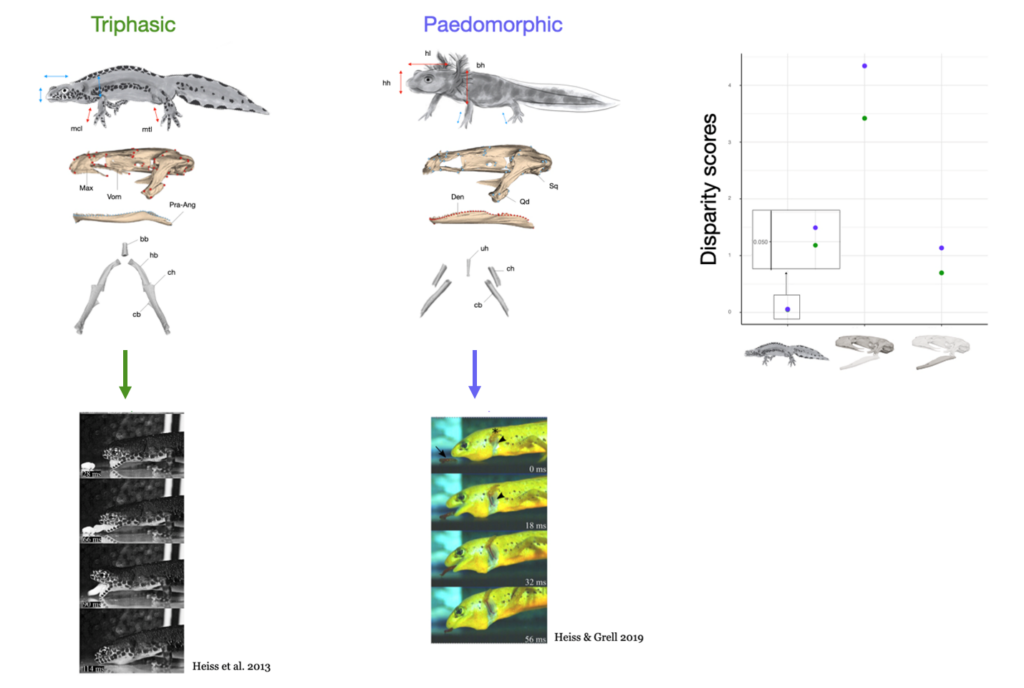
La morphologie corporelle a été étudiée à l'aide de mesures prélevés sur différentes parties du corps. En ce qui concerne les os du crâne, dont l'étude directe s'avère bien plus difficile, les spécimens ont été Scanné aux rayons X pour obtenir des modèles tridimensionnels des os. Nous avons ensuite utilisé une méthode appelée morphométrie géométrique, ce qui permet d'effectuer des comparaisons précises des formes osseuses.
Qu'avons-nous découvert ?
© Morgane Fournier
Nos résultats montrent que individus pédomorphes sont plus petit et présentent des caractéristiques morphologiques adapté à la vie aquatique. Par exemple, leurs métacarpiens (certains os des membres antérieurs) sont relativement plus courts, ce qui pourrait être lié à une utilisation différente de leurs membres lorsqu’ils se déplacent dans l’eau. Les os de la tête présentent également une morphologie particulièrement bien adaptée à aspiration, une méthode d'alimentation très efficace en milieu aquatique.
Clique ici si vous souhaitez en savoir plus sur l'alimentation par succion chez les salamandres.
Nous avons également cherché à déterminer si la pédomorphose modifie la manière dont les différents os se développent les uns par rapport aux autres. Certains os peuvent se développer de manière relativement indépendante ; dans ce cas, on dit qu’ils sont plus modulaire. À l'inverse, lorsque les modifications de la forme d'un os sont étroitement liées à celles d'autres os, le système est plus intégré. Nos résultats montrent que, malgré des différences morphologiques, la pédomorphose n'altère pas cette organisation du développement osseux chez le triton alpin.
En revanche, les populations pédomorphes présentent une plus grande diversité morphologique (scores de disparité). Cette diversité pourrait s'expliquer par le fait que l'arrêt de la métamorphose ne survient pas exactement au même moment chez tous les individus. Certains ont donc subi davantage de remodelage que d'autres, ce qui se traduit par une plus grande variation dans la forme de leurs os.
Ces résultats sont particulièrement intéressants dans le contexte actuel, car les populations pédomorphes dépendent d'environnements aquatiques permanents relativement exempts de prédateurs. Elles sont donc très sensible aux perturbations environnementales, telles que l'introduction d'espèces de poissons, la dégradation des habitats, les modifications hydrologiques et le changement climatique. Une meilleure compréhension des conséquences morphologiques des différentes stratégies de cycle de vie permet ainsi de mieux cerner non seulement les contraintes auxquelles ces populations sont confrontées, mais aussi leur capacité à s'adapter aux changements de leur environnement.
Si vous souhaitez en savoir plus, vous pouvez consulter l'article ici!





C'est super intéressant, Morgane ! Un excellent résumé pour ceux qui, comme moi, n'y connaissent rien en métamorphose 🙂 Je vais tout de suite lire l'article 🙂