

It is our great pleasure to share with you the main findings of our study, published in Biology Open, in which we investigated the impact of metamorphosis and size on the aquatic feeding kinematics of the Iberian ribbed newt (Pleurodeles waltl Michahelles, 1830).
No pain, no gain: the benefits of metamorphosis may outweigh its costs!
When a salamander larva metamorphoses into its adult form, the process comes at a high metabolic cost. It may lose weight, struggle to feed, and become weaker and more vulnerable to predators. In the worst cases, it may not survive. At first sight, then, it is difficult to understand why such a costly process has evolved and been maintained.
Yet metamorphosis is far from being unique to amphibians. It is widespread across the animal kingdom: more than 80% of insects and over half of vertebrates are undergoing a metamorphosis. So, this suggests that the benefits of metamorphosis may outweigh its costs.
One of the main explanations is provided by the adaptive decoupling hypothesis. It proposes that metamorphosis breaks the link between larval and adult phenotypes. This may result in two main advantages. First, each stage can specialize in different resources (food, environment), reducing competition between larvae and adults. Second, each stage can be better adapted to the specific selective pressures it faces. Together, these advantages may increase survival throughout the life cycle.
The Iberian ribbed newt and its unusual biphasic life cycle
If the adaptive decoupling hypothesis holds, we should also detect differences in the performance of functions associated with body parts that are remodeled during metamorphosis. This is particularly clear when metamorphosis is accompanied by a shift from an aquatic to a terrestrial environment, as in most biphasic salamanders. Indeed, metamorphosis is associated with major morphological changes linked to this shift in lifestyle. The most striking examples are the locomotor and feeding systems. Larvae swim to move and use suction feeding to capture prey, whereas metamorphosed individuals can walk on land and use tongue prehension (see example of tongue prehension here).
But what happens when metamorphosis does not involve a major change in lifestyle? Does functional decoupling still occur? This is the question we addressed by studying feeding kinematics in the Iberian ribbed newt, a salamander native to the central and southern Iberian Peninsula and northern Morocco. This biphasic species has the unusual ability to remain aquatic throughout its life when ponds are permanent. As a result, although larvae and metamorphs have distinct morphologies, they share the same environment, meaning they face similar ecological constraints, and they also keep using suction feeding to catch prey (see video below).
Same feeding, different flow: one subtle difference between larvae and adults
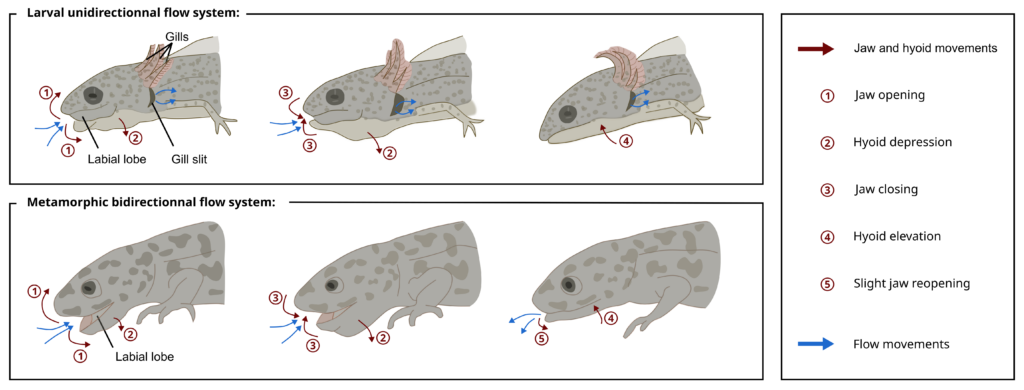
Suction feeding relies mainly on the rapid expansion of the buccal cavity, driven by mouth opening and the almost simultaneous depression of the hyoid. Together, these movements create negative pressure inside the mouth, generating a flow that draws water and prey in. The jaws then close to secure the prey, followed by hyoid elevation, which expels the excess water before swallowing.
Although larvae and metamorphs use the same basic feeding mechanism, there is one subtle difference regarding the expulsion of water. In larvae, water enters through the mouth and exits through the gill slits openings at the back of the head. This creates a unidirectional flow system, with water flowing in one direction through the head. In metamorphosed individuals, the gill slits have been resorbed during metamorphosis. Water must therefore be expelled through the mouth, reversing the flow. Because water both enters and exits through the mouth, this is known as a bidirectional flow system.
Our statistical recipe for testing the hypothesis
Even so, it was still unclear whether larvae and metamorphs actually differed in their suction-feeding kinematics. Moreover, we wanted to know whether these potential differences could simply be explained by body size. To answer these questions, we recorded high-speed videos of 9 larvae and 10 metamorphosed Iberian ribbed newts of increasing sizes.
From these videos, we measured buccal expansion metrics, as well as the duration of mouth and hyoid movements during suction feeding. The statistical design we used allowed us to answer three simple questions: Does size matter? Does developmental stage matter? And do size and developmental stage have a joint effect on the variable?
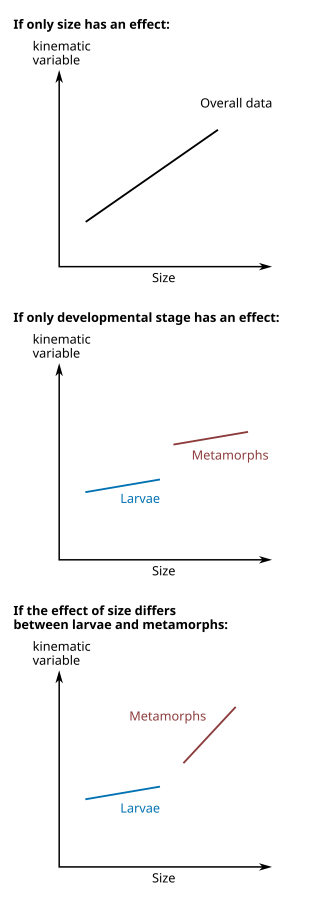
When we plot the kinematic measurements against body size, we can visualize how these measurements change as the animals grow. Three main patterns can be expected depending on the answer:
- If only size has an effect, larvae and metamorphs follow the same relationship with size. They can therefore be described by a single regression line.
- If developmental stage has an effect independently of size, larvae and metamorphs have different values, but their relationship with size remains the same. This results in two parallel regression lines with different intercepts.
- If the effect of size differs between larvae and metamorphs, both the slope and the intercept of their regression lines differ.
Buccal expansion: getting bigger and better at catching prey
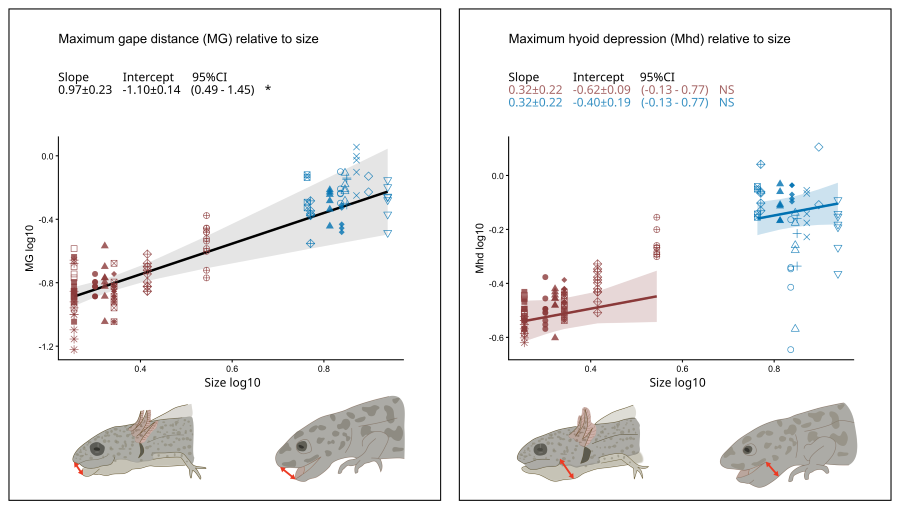
The buccal expansion metrics were the only variables not affected by a joint effect of size and developmental stage. Mouth opening increased with size alone, while hyoid depression was affected by developmental stage only, with greater values in metamorphs. Together, these results suggest that the ability to capture larger prey increases with body size and may be further enhanced after metamorphosis through greater hyoid depression.
From slow to speedy: how development changes feeding timing
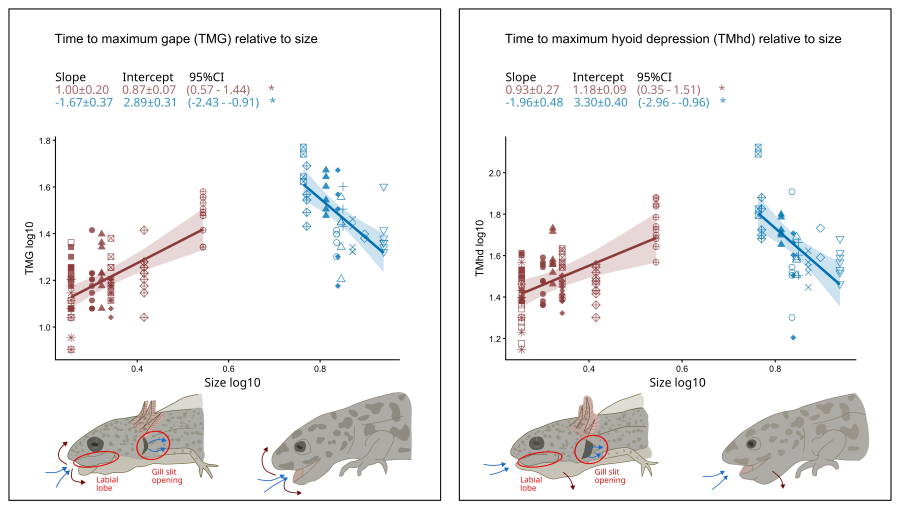
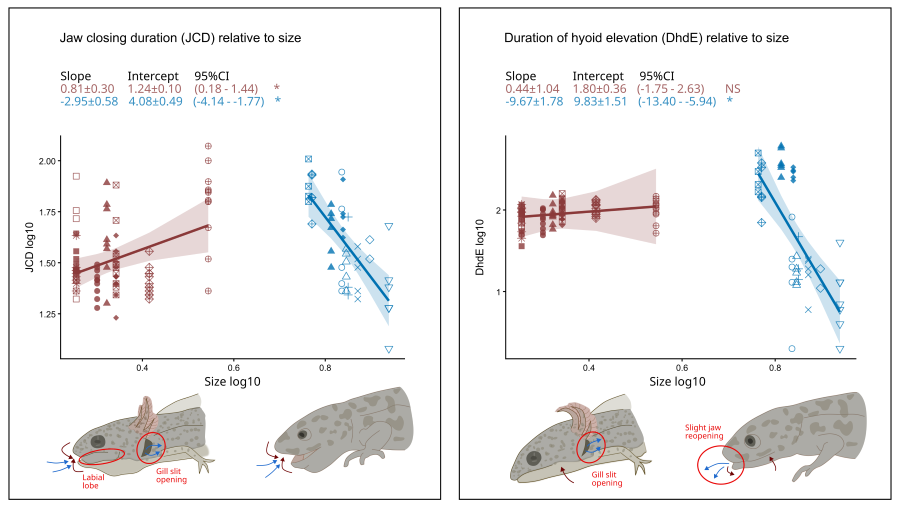
Regarding the duration variables, they were all affected by a joint effect of size and developmental stage, with a consistent pattern: durations increased with size in larvae but decreased with size in metamorphs. Ultimately, this means that, relative to their size, metamorphs had faster movements than larvae.
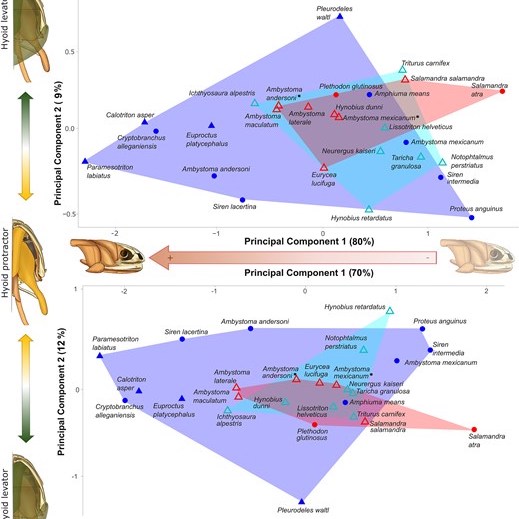
This pattern coincides with differences in skull ossification between larvae and metamorphs (see illustration from Smirnov et al. 2020 here). The larval cranium is mostly cartilaginous, whereas during metamorphosis, a peak in thyroid hormone promotes the ossification and differentiation of the metamorphic cranium.
Yet, muscles can act more effectively on ossified bones because their rigidity allows muscle forces to be transmitted more directly. In contrast, cartilaginous bones are more flexible and can deform during muscle contraction, thus dissipating part of the force produced and reducing the efficiency of the movement.
Two ways to boost suction
Compared with larvae, metamorphs have faster buccal expansion movements, which may allow them to reach peak flow velocity sooner, a strategy known to increase suction force. However, slower buccal expansion in larvae does not necessarily mean weaker suction. Instead, they may compensate with their extensive labial lobes, the flaps of skin connecting the upper and lower jaws. These structures are known to increase suction efficiency by reducing the size of the mouth opening. In addition, larvae may further reinforce suction through the opening of the gill slits, which begins during the buccal expansion phase and allows water to continue flowing from the mouth toward the back of the head.
Keeping prey from getting away
In metamorphs, the bidirectional flow system makes the final phases of suction particularly challenging. After maximum hyoid depression, the flow reverses, and metamorphs must slightly reopen their mouths to expel water. These events may give prey an opportunity to escape. Therefore, shortening the duration of jaw closing and hyoid elevation through faster movements may help reduce the risk of prey escape. In larvae, although movements are slower, the risk of prey escape may also be reduced by their labial lobes, which occlude the lateral parts of the mouth. In addition, the opening of the gill slits helps maintain suction toward the back of the head, potentially drawing prey deeper into the throat and reducing its chance of escape.
Different tools, same goal
To conclude, metamorphosis changes the relationships between body size (SVL) and most of our kinematic variables, which is in line with the adaptive decoupling hypothesis. However, further studies are needed to determine whether this functional decoupling is accompanied by reduced competition between developmental stages, as predicted by the hypothesis. Especially since our results rather suggest a morpho-functional trade-off: larvae may enhance suction and prey retention through their labial lobes and gill slits, whereas metamorphs may compensate for the loss of these larval structures with faster movements enabled by cranial ossification.