


Do you remember when we filmed prey-capture sequences of olms and Pyrenean brook newts at the Moulis Laboratory Cave ?
Thanks to Noah Heier, a Master’s student who joined us for his internship, we were able to analyze the Pyrenean brook newt dataset and complement it with a series of new experiments. I’m very happy to share the main findings of this work, which have just been published in the Journal of Experimental Zoology Part A.
Living in a Cave: The ultimate survival challenge
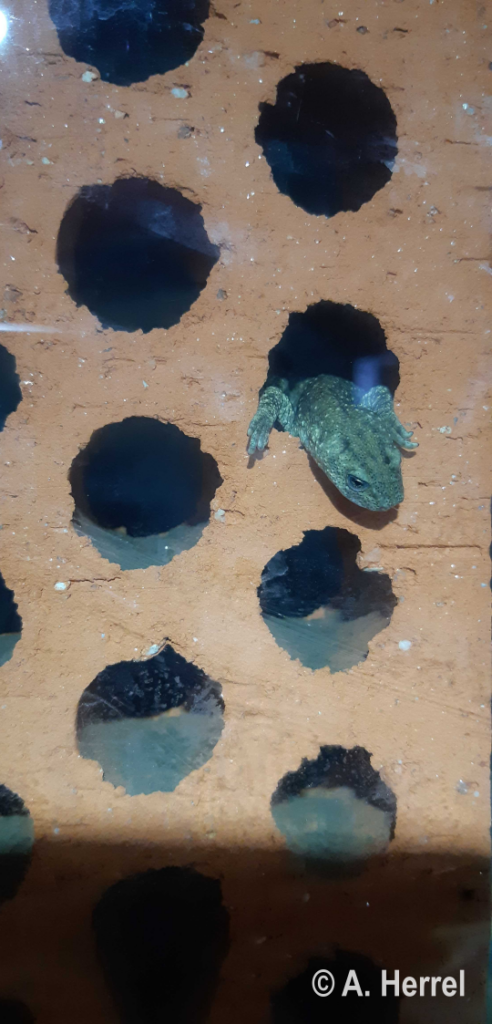
Caves are extreme environments, with no light, high humidity, and limited food. These conditions impose strong selective pressures on organisms. As a result, many cave dwellers, such as the olm, have evolved remarkable traits, including loss of eyes, depigmentation, and a low resting metabolic rate. But how does adaptation to cave life begin? The Pyrenean brook newt is ideal to understand the initial stages of adaptation of adaptation to life underground. This salamander has two genetically distinct morphotypes: one living in surface streams and the other in cave streams, yet they show no obvious morphological differences.
So, we took this opportunity to test whether cave-dwelling and surface-dwelling populations differed in their ability to locate prey and in their feeding movements. We tested them both under their usual hunting conditions (darkness for cave dwellers and light for surface dwellers) and under the conditions experienced by the other population (light for cave dwellers and darkness for surface dwellers).
The food-finding race: an escape game in a Y-maze
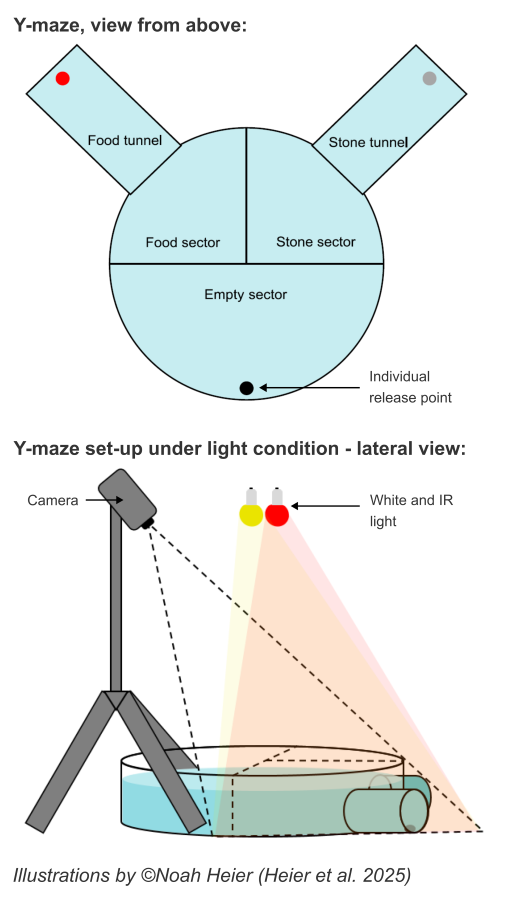
To complement our kinematic data, we used a Y-maze to test whether prey-finding ability and exploratory behavior differed depending on population origin and light conditions. The maze consisted of a circular open area connected to two tunnels positioned at a 45° angle from each other. At the end of one tunnel, we placed a tea bag filled with bloodworms, while the other contained a similarly sized and shaped stone. The position of the food was randomized between the two tunnels. Each salamander was then placed in the maze and its behavior was recorded for 15 minutes. Individuals from each group were tested 10 times.
As expected, salamanders generally spent more time in the area containing food than in the other areas. By contrast, although cave-dwelling individuals are used to hunting in complete darkness, our prediction that they would be faster at detecting prey was not supported. Under both light and dark conditions, the time needed to locate the prey did not significantly differ between cave- and surface-dwelling salamanders tested under the same conditions.
Instead, the differences we observed were more strongly associated with light conditions than with population origin. Under light conditions, both cave- and surface-dwelling salamanders showed more exploratory behavior: they entered the tunnels more frequently and spent more time inspecting the stone area, likely because they could use vision to explore their surroundings.
Lastly, when salamanders were tested under the light conditions of the other population, we observed some interesting behavioral responses. Surface-dwelling salamanders tested in complete darkness spent more time in the food area and stayed close to the prey for longer after finding it than when tested in the light. This could indicate that, when vision was unavailable, they relied more strongly on other senses, such as smell, to detect and locate food. Interestingly, cave-dwelling salamanders tested in the light also showed a distinct response: they were the only group to preferentially enter the food tunnel first. In all other groups, the first choice did not differ from random.
Together, these results suggest that both cave- and surface-dwelling populations can adjust their behavior depending on the sensory information available to them.
The Salamander’s guide to hunting with or without light
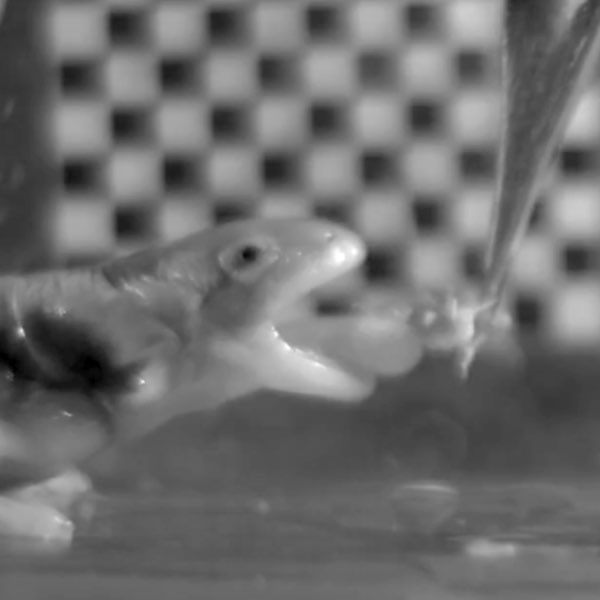
In our previous blog post, we showed a prey-capture video in real time. Bellow, you can watch the same behavior in slow motion.
Pyrenean brook newts use suction feeding to capture prey. This aquatic feeding strategy relies on the rapid expansion of the buccal cavity, which generates a flow of water that draws the prey into the mouth. However, their suction-feeding behaviour varied with lighting conditions.
In the light, when newts could see their prey, they tended to adopt a “ram” behaviour. They lunged towards the prey using their forelimbs and tail, opening their mouths only when they were close. This movement allowed them to generate compensatory suction as they approached their prey.
In the dark, when they could not see their prey, they instead preferred a “static” behaviour. They positioned themselves just above the prey, with a lower head angle, and relied mainly on inertial suction to capture prey directly in front of their mouths. By positioning their mouths close to the surface, they may also have benefited from wall effects, which have been shown to enhance suction performance.
These changes in feeding strategy were independent of population origin, highlighting the behavioral flexibility of this species. Both surface- and cave-dwelling newts were able to use both types of suction behavior, demonstrating their capacity to adjust their feeding strategy to different environmental conditions.
Habitat Leaves a subtle mark on the feeding strike
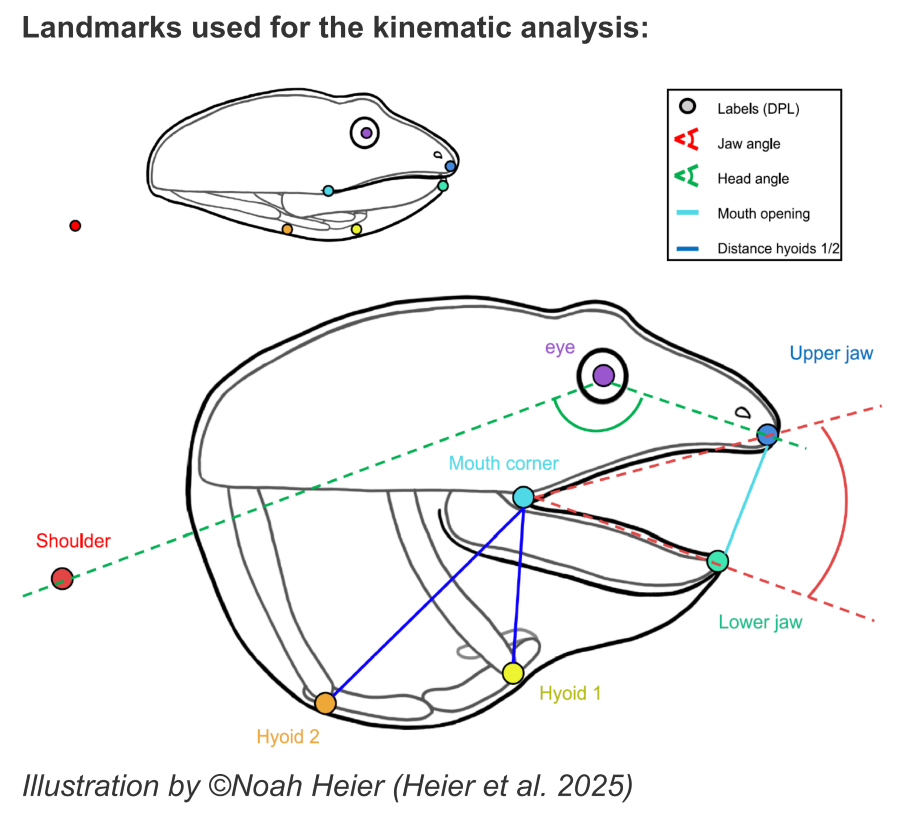
We also found a few differences in feeding kinematics depending on population origin and lighting conditions.
The strongest differences in prey-capture kinematics emerged when we compared surface- and cave-dwelling individuals under their respective natural lighting conditions, suggesting subtle adaptive differences in feeding kinematics associated with their habitat.
Moreover, when individuals were exposed to the lighting conditions of the other population, they modified aspects of their feeding kinematics in response to the new conditions, but appeared to overcompensate in some movements. This suggests that they may be less efficient under unfamiliar lighting conditions than individuals accustomed to them.
Flexibility is their greatest strength!
So, who hunts best? In fact, the subtle differences in feeding kinematics between populations under their native lighting conditions suggest that each population may have evolved slight kinematic adaptations to its respective habitat. Otherwise, exploratory behavior was overall rather similar between populations, and both surface- and cave-dwelling Pyrenean brook newt detected food equally well, using both vision and olfaction.
However, the most striking finding of this study was the remarkable behavioral flexibility of the Pyrenean brook newt. Both cave- and surface-dwelling populations were able to adjust their feeding behavior to different light conditions, switching between hunting strategies depending on the sensory information available to them. This behavioral flexibility may have played an important role in allowing the species to colonize the extreme environment of caves.